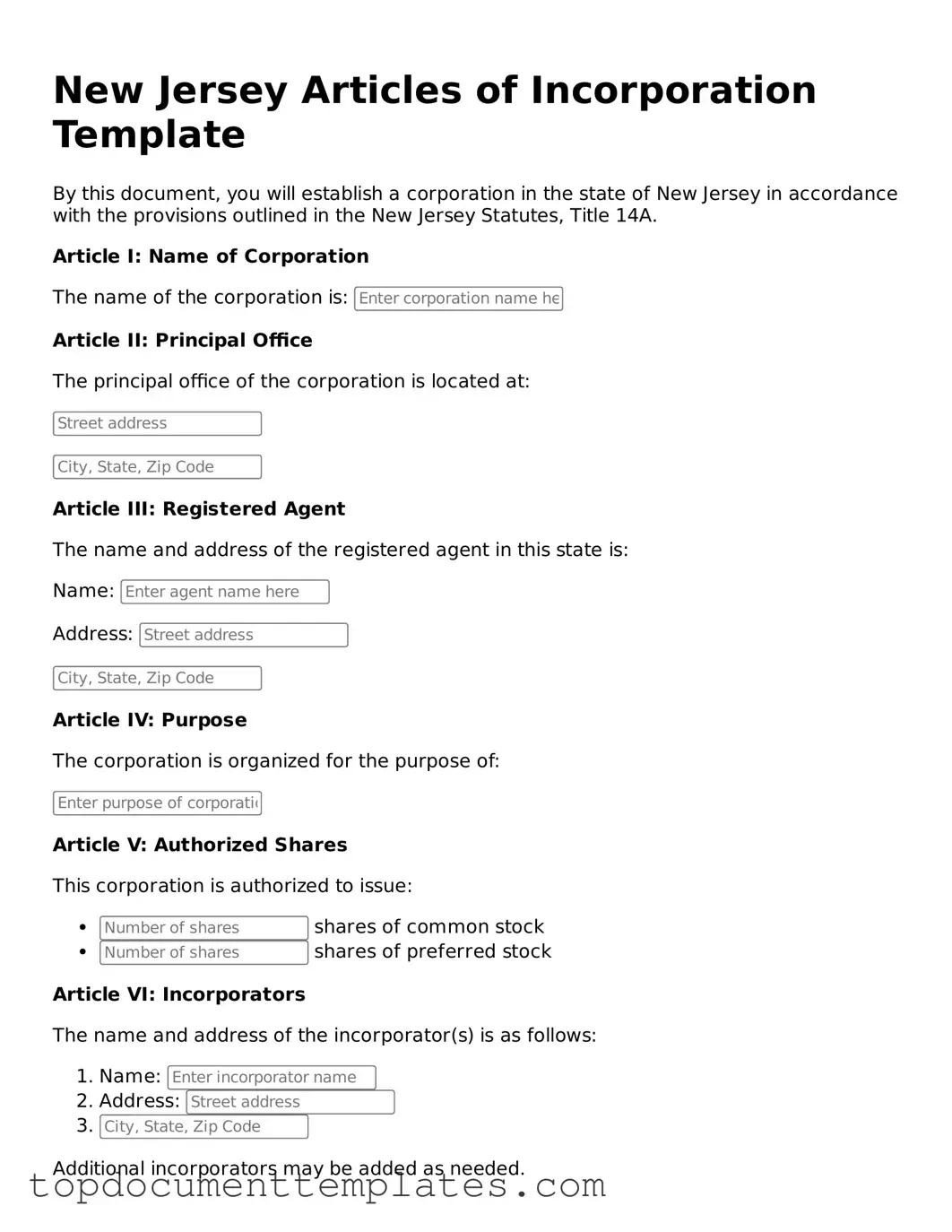
Valid Articles of Incorporation Form for New Jersey State
In New Jersey, the Articles of Incorporation form serves as a crucial document for individuals and groups looking to establish a corporation. This form lays the groundwork for your business by providing essential information such as the corporation's name, its purpose, and the registered agent's contact details. Additionally, it outlines the number of shares the corporation is authorized to issue and the names and addresses of the initial directors. By completing this form, you not only comply with state requirements but also set the stage for your corporation's legal identity. Understanding each section of the Articles of Incorporation is vital for ensuring that your business starts on a solid foundation and meets all regulatory standards. This article will guide you through the major aspects of the form, highlighting the importance of accuracy and clarity in each entry, as well as the implications of your choices on your corporation's future operations.
Similar forms
The Articles of Incorporation is a vital document for establishing a corporation. However, it shares similarities with several other important documents in the business world. Here are six documents that have comparable functions or purposes:
- Bylaws: These outline the internal rules and procedures for managing a corporation. While the Articles of Incorporation set up the corporation, the bylaws govern its day-to-day operations.
- Power of Attorney: A Power of Attorney form in Texas is crucial for ensuring that a person's financial and legal decisions are managed according to their wishes. For more information, visit TopTemplates.info.
- Operating Agreement: This document is similar to bylaws but is specifically for limited liability companies (LLCs). It details the management structure and operational procedures, akin to how bylaws function for corporations.
- Certificate of Formation: Often used interchangeably with Articles of Incorporation, this document is required to officially form a corporation in some states. It serves the same foundational purpose of establishing a legal entity.
- Partnership Agreement: This document outlines the rights and responsibilities of partners in a business partnership. Like the Articles of Incorporation, it formalizes the relationship and structure of the business entity.
- Business License: While not a formation document, a business license is necessary for legal operation. It ensures compliance with local laws, similar to how the Articles of Incorporation ensure compliance with state regulations.
- Tax Identification Number (EIN): This number is essential for tax purposes and is required for corporations to operate legally. It is similar in that it legitimizes the corporation in the eyes of the government, much like the Articles of Incorporation do at the state level.
Guidelines on Writing New Jersey Articles of Incorporation
Once you have gathered the necessary information, you can begin filling out the New Jersey Articles of Incorporation form. This form is crucial for establishing your business entity in the state. Following the steps below will help ensure that you complete the form accurately.
- Begin by entering the name of your corporation. Ensure that the name is unique and complies with New Jersey naming regulations.
- Provide the address of the corporation's principal office. This should be a physical address, not a P.O. Box.
- Specify the purpose of your corporation. You may include a brief description of the business activities you plan to conduct.
- Indicate the duration of the corporation. Most corporations are set up to exist perpetually unless otherwise specified.
- List the name and address of the registered agent. This person or entity will be responsible for receiving legal documents on behalf of the corporation.
- Include the names and addresses of the initial directors. This information is essential for the formation of your board of directors.
- Provide the total number of shares the corporation is authorized to issue, along with the par value of each share, if applicable.
- Sign and date the form. The signature must be from an incorporator or an authorized individual.
- Review the completed form for accuracy. Ensure all required fields are filled out and that there are no errors.
- Submit the form along with the required filing fee to the appropriate New Jersey state office. Be sure to keep a copy for your records.
File Information
| Fact Name | Description |
|---|---|
| Purpose | The New Jersey Articles of Incorporation form is used to officially create a corporation in the state of New Jersey. |
| Governing Law | The form is governed by the New Jersey Business Corporation Act (N.J.S.A. 14A:1-1 et seq.). |
| Filing Requirement | Filing the Articles of Incorporation with the New Jersey Division of Revenue and Enterprise Services is mandatory for incorporation. |
| Information Needed | Key information required includes the corporation's name, address, registered agent, and the purpose of the business. |
| Fees | A filing fee is required when submitting the Articles of Incorporation, which is subject to change. |
| Approval Process | Upon review and approval, the state issues a Certificate of Incorporation, confirming the corporation's legal existence. |
Other Popular Articles of Incorporation State Forms
File Articles of Incorporation California - Certain states may require additional documentation along with the Articles.
Michigan Articles of Organization - The Articles may outline how conflicts among shareholders are to be resolved.
The process of submitting the California Homeschool Letter of Intent form requires attention to detail and a clear understanding of the guidelines set forth by the state. This essential document not only informs the local school district about your homeschooling decision but also aligns with legislative requirements. For further information on how to properly complete and submit this form, you can visit https://onlinelawdocs.com.
Florida Articles of Incorporation - Different states may have unique requirements, affecting how the Articles are prepared and filed.